

United Kingdom · Manufacturing & Supply Chain
You found a factory with a good price and a fast reply. That is not the same as finding a supplier you can trust with your product.
What this guide covers
- Why One Bad Supplier Can Undo a Year of Planning
- What to Check Before You Even Pick Up the Phone
- The Site Visit Questions That Separate Factories From Middlemen
- How to Read a Quality System Without Being an Engineer
- The Red Flags That Should Stop You Signing Anything
- Building a Backup Supplier Plan Before You Need One
- Frequently Asked Questions
Key Takeaways
- Supplier sourcing mistakes are expensive to undo once tooling, deposits and timelines are committed.
- Check business registration, export licences and bank details before any deposit leaves your account.
- A site visit, in person or by video, tells you more than any brochure or sample ever will.
- Ask to see a quality system in action, not just a certificate on a wall.
- Most companies do not have a backup supplier ready, which turns one problem into a crisis.
- A structured checklist turns supplier sourcing from a gamble into a repeatable process.
Most product delays do not start on the factory floor. They start weeks earlier, at the point someone chose a supplier without checking enough.
A low quote looks like a win in a spreadsheet. It stops looking like a win when the first shipment fails inspection, the factory goes quiet, or the person you have been emailing turns out not to work at the factory at all.
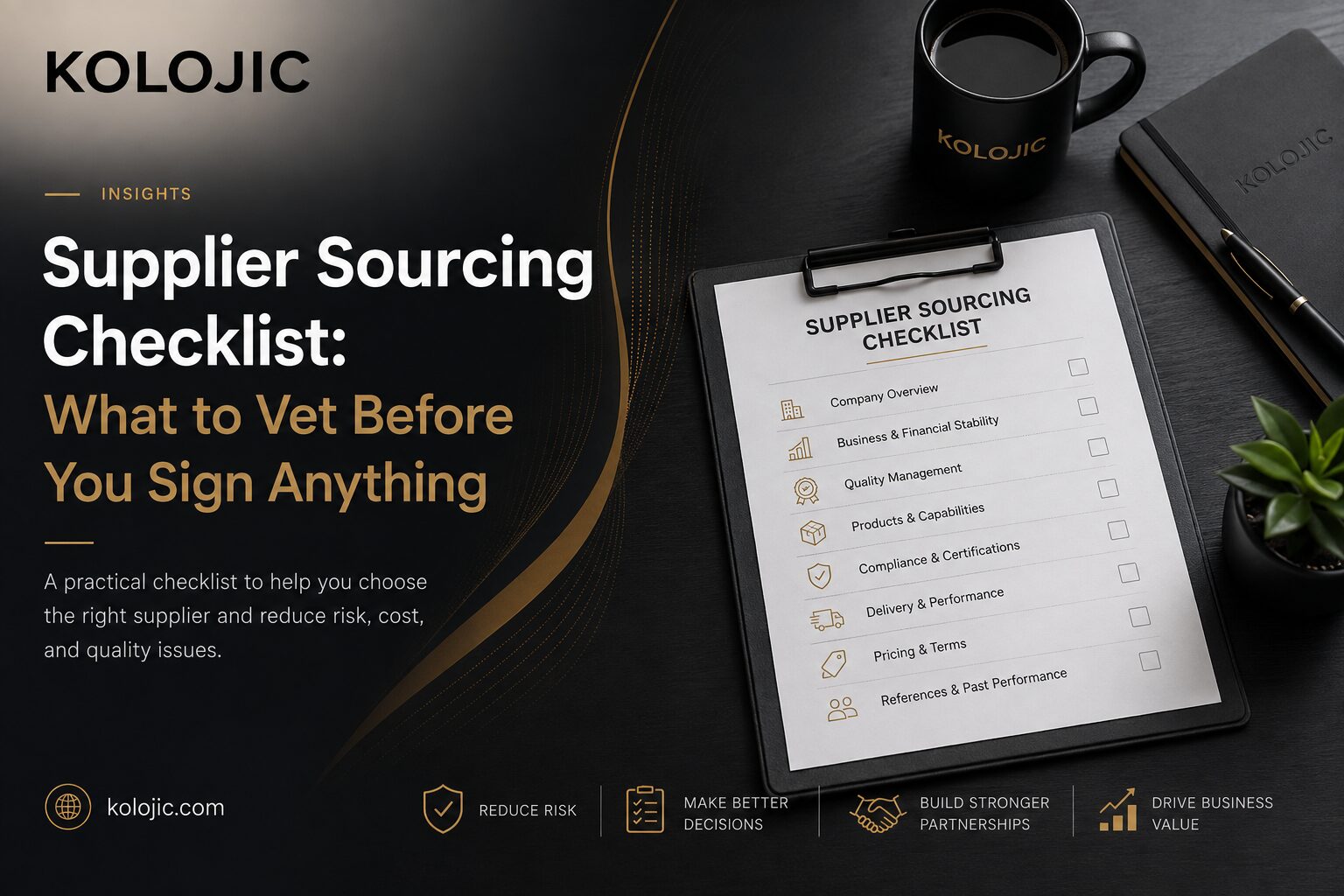
This guide walks through what to check before you commit to a manufacturing partner, in an order that matches how sourcing actually happens. By the end, you will have a working checklist and a clear view of where quality inspection services fit into the process.
Why One Bad Supplier Can Undo a Year of Planning
A weak supplier does not usually fail on day one. It fails after you have paid a deposit, booked shipping, and told your own customers a date.
By that point, switching is slow and costly. You have sunk cost, a half finished production run, and no second option ready to go. This is why supplier sourcing has to happen before the relationship, not during it.
Getting it right early means fewer surprises later, on cost, on lead time, and on the quality landing on your customer's desk.
The three things a rushed sourcing process usually skips
Teams under time pressure tend to skip the same three checks: confirming who actually owns the factory, checking financial stability, and asking for a reference from another customer. Each one takes an afternoon. Skipping all three can cost months.
The Vetting Journey
Three stages, three levels of risk if you skip them
What to Check Before You Even Pick Up the Phone
Start with documents. A legitimate manufacturing partner will have registration paperwork, export licences where relevant, and a bank account that matches the company name on every invoice.
None of this needs a site visit. It is desk work, and it filters out a surprising number of unsuitable suppliers before you spend real time on them.
Documents worth requesting
Ask for the business registration number, the registered address, and confirmation of who legally owns the factory. Ask whether the company you are talking to is the actual manufacturer or a trading agent working on commission. Both can be fine, but you need to know which one you are dealing with.
Ask for a bank account confirmation that matches the company name on the invoice. This one check catches more payment fraud than any other single step in the process.
The Site Visit Questions That Separate Factories From Middlemen
A video call walkthrough or an in person visit answers a question no brochure can: does this factory actually make what they say they make, or does it get made somewhere else and relabelled?
Walk the production line. Ask to see the machines running your type of product, not just the showroom samples. Ask how many other clients share the same production line and what happens to your order if a larger client's rush job comes in.
Four Stages of Supplier Vetting
A repeatable sequence for evaluating a manufacturing partner
How to Read a Quality System Without Being an Engineer
You do not need to be a quality engineer to tell the difference between a factory that manages quality and one that hopes for the best.
Ask to see the incoming material inspection log. A factory with no record of checking materials as they arrive cannot reliably produce consistent output, whatever its finished samples look like. This is precisely what independent quality inspection services are built to verify, because a buyer cannot always tell from a sample alone.
The international benchmark here is ISO 9001, the quality management standard most manufacturing partners will reference. A certificate on the wall is a starting point, not proof. Ask when the last internal audit happened and what it found.
| Desk Research | Full Factory Audit | |
|---|---|---|
| Cost | Low, mostly your own time | Higher, often a paid third party fee |
| Time | A few hours to a day | Several days including travel or booking |
| What it reveals | Paperwork, reputation, basic legitimacy | Real production capacity, working conditions, live QC |
| Best for | Early filtering of many candidates | Final check before a large or repeat order |
What a Reliable Manufacturing Partner Looks Like
Four signals worth checking before you commit
Certifications
Current, verifiable, and relevant to your product category.
Communication
Clear, timely answers, even when the news is not good.
Capacity
Enough spare production line time to take your order seriously.
Contingency
A plan for delays, defects, and unannounced follow-up checks.
The Red Flags That Should Stop You Signing Anything
Some warning signs are easy to miss when you are excited about a good price. Refusal to allow an unannounced follow-up visit is one. So is a factory that cannot explain who made your product if it turns out not to be them.
Choosing a supplier on price and sample quality alone, then discovering during production that the sample was hand finished by a different team to the one running your actual order.
The Chartered Institute of Procurement and Supply frames this as ongoing evaluation rather than a one time check, and that framing matters. A supplier that passed vetting a year ago is not guaranteed to still meet the same standard today.
Building a Backup Supplier Plan Before You Need One
The businesses that recover fastest from a supplier problem are the ones who already had a second option lined up. Everyone else scrambles.
A backup does not need to be active. It can simply be a pre-vetted manufacturing partner you have already spoken with, sampled, and could activate within weeks rather than months if your primary supplier lets you down.
Building that backup relationship costs a small amount of time now. Not having one costs far more later, at exactly the moment you can least afford the delay.
Frequently Asked Questions
What should I check first when sourcing a new supplier?
Start with documentation. Confirm the business registration, the registered address, and whether the company is the actual manufacturer or a trading agent. This desk work filters out unsuitable suppliers before you spend time or money on samples and site visits.
Is a factory certificate enough proof of quality?
A certificate is a starting point, not proof on its own. Ask when the factory's last internal audit happened, what it found, and ask to see the incoming material inspection log. Independent quality inspection services can verify what a certificate alone cannot.
How important is a site visit before signing a supplier contract?
Very important. A site visit, in person or by video walkthrough, confirms the factory actually makes your product rather than relabelling goods made elsewhere. It also reveals production capacity and how your order compares to other clients on the same line.
What are the biggest red flags in supplier sourcing?
Refusing an unannounced follow-up audit, being unable to confirm who actually manufactures the product, and bank details that do not match the company name on invoices. Any one of these is a reason to slow down before paying a deposit.
Should I always have a backup supplier?
Yes, where the order is significant enough that a delay would hurt your business. Most companies do not have one ready, which is why a single supplier failure can stall a production line for months rather than weeks.
How do UK businesses vet overseas manufacturing partners?
The same checklist applies, with extra attention to export licences, incoterms, and third party inspection before goods leave the country of origin. A local sourcing consultant can also run or commission the factory audit on your behalf.
Ready to Vet Your Next Manufacturing Partner Properly?
KOLOJIC works alongside UK businesses to source, audit and manage manufacturing partners end to end, so you are not guessing on your next order.
Book a Free Strategy Call →